



For many foreign businesses entering Thailand, the plan sounds simple:
- Register a company.
- Import the products.
- Start selling.
In practice, company registration is only the first layer.
A Thai company may legally exist but still not be ready to import or sell. The requirements depend on its ownership, activities, product classification, premises and sales channels.
The better question is not simply, “How do we register a company in Thailand?”
It is: “What must be in place for this product to enter Thailand and be sold legally?”
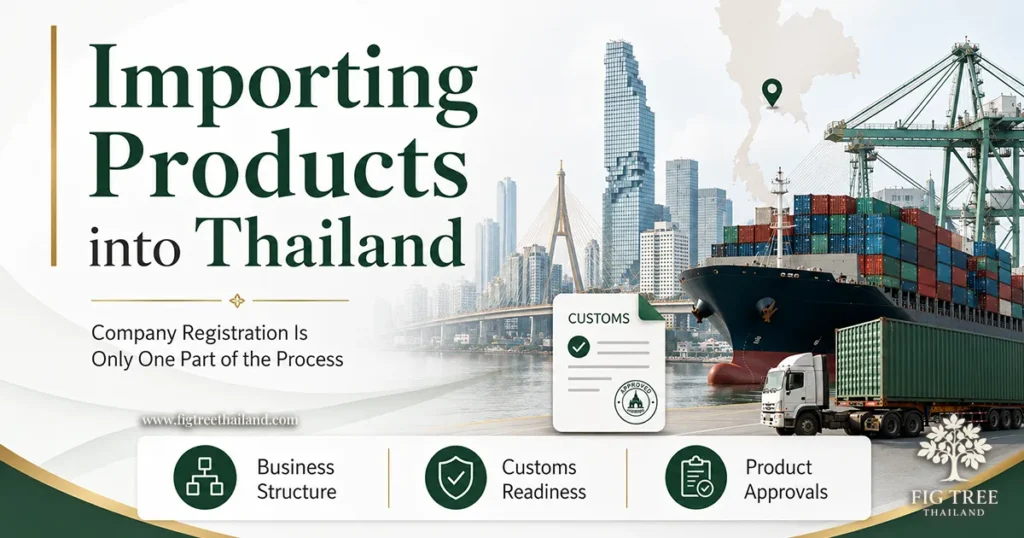
Three areas to review before importing
1. Business structure and permitted activities
Importing is only one part of the operation. The Thai company may also act as a wholesaler, retailer, distributor, online seller or service provider.
This matters when the company has foreign shareholders. Importing goods does not automatically allow a foreign-owned company to conduct every related activity. Wholesale, retail and certain services may be subject to foreign business restrictions unless an exemption or permission applies.
Before choosing the company structure, clarify:
- Who will own the Thai company?
- Who will purchase the goods and act as importer of record?
- Will the company sell wholesale, retail, online or through a distributor?
- Will it provide related services, and where will the products be stored?
These answers shape both the legal structure and the licences the business may need.
2. Customs and importer readiness
The importing entity must be ready for Thai Customs procedures. Commercial importers generally need access to the e-Customs system, either directly or through an authorised customs broker.
Each shipment needs the correct HS code, customs value and documents, such as the invoice, packing list, transport document, certificate of origin and any required permit.
The HS code affects import duty and can indicate whether another authority regulates the goods.
A customs broker can assist, but the importer remains responsible for the declaration and the goods. Classification should be confirmed before the shipment reaches Thailand.
3. Product and premises approvals
Thailand does not have one import licence that covers every product. Requirements depend on what the product is, how it will be used and what claims are made about it.
Food, cosmetics and medical devices may require Thai FDA licensing, notification or approval. Certain industrial products must meet mandatory Thai Industrial Standards. Chemicals, telecommunications equipment, agricultural goods and other controlled products may fall under separate authorities.
Premises can form part of the approval. A virtual office may work for company registration but may not satisfy import or storage requirements for regulated products.
This is why signing a long lease before checking the regulatory conditions can create unnecessary cost and delay.
Overseas approval does not automatically transfer to Thailand
A product that is legally sold in another country is not automatically compliant in Thailand.
Thai labels, warnings, ingredient details, importer information or registration numbers may be required. Advertising claims can also affect classification.
The manufacturer may need to provide specifications, certificates, test reports or authorisation. Some documents may require translation, notarisation or legalisation.
Confirm the document list early to avoid preventable launch delays.
A practical planning sequence
The exact process varies by product, but a sensible order is:
- Define the product, intended use, claims and sales channels.
- Confirm the product classification and responsible authority.
- Review ownership and permitted business activities.
- Identify importer, product, premises and labelling requirements.
- Prepare the supplier documents and select suitable premises.
- Complete company, Customs and regulatory registrations in the correct order.
- Ship commercial goods only after the required approvals are in place.
This is usually faster than discovering a missing licence when the products are already in transit.
Company registration creates the vehicle, not the complete operating route
For an import business, the company is the legal vehicle. It still needs the correct activities, Customs readiness, product approvals, premises and documentation.
At Fig Tree, we help foreign investors connect these requirements before committing to a structure, shipment, warehouse or launch date. The objective is an operating route that works in practice.
Planning to import and sell products in Thailand?
Contact Fig Tree for an initial review of your business structure, product category and licensing pathway.
Website: www.figtreethailand.com
Email: info@figtreethailand.com
Phone / WhatsApp: +66 61 449 2616
This article provides general information only. Requirements vary by product, business model and regulatory classification and should be confirmed for each project.
Frequently asked questions
Can a newly registered Thai company import products immediately?
Not necessarily. It may still need Customs registration, product approval, an importer licence, compliant premises or other permissions before commercial importation.
Does every imported product need Thai FDA approval?
No. Thai FDA requirements apply to product categories under its authority. Other goods may be regulated by TISI or another agency, while some products may not require specific approval.
Can a foreign-owned company import and sell products in Thailand?
Possibly, but the complete business model must be reviewed. Importation, wholesale, retail, online sales and related services can raise different ownership and permission issues.