



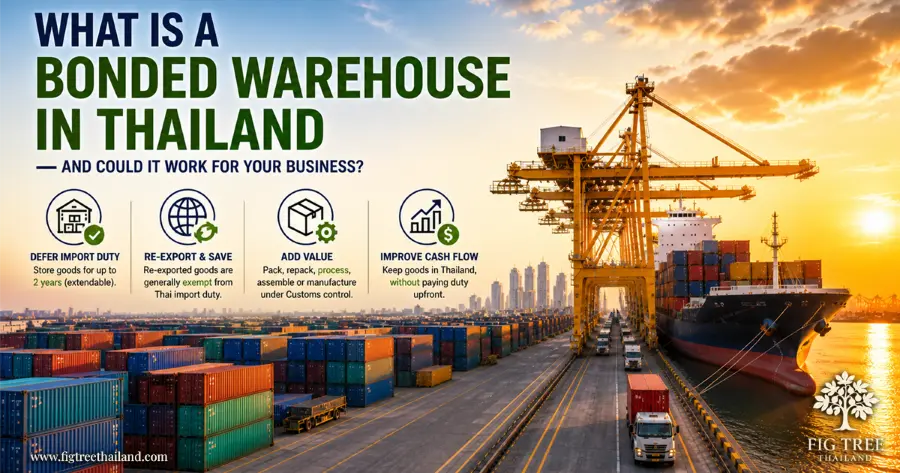
For many importers, paying import duty as soon as goods clear Thai Customs can feel like the only available option.
But in Thailand, that is not always the case.
A bonded warehouse in Thailand is a recognised customs facility that allows imported goods to be stored under Customs control without import duty being triggered immediately. In some cases, if the goods are later re-exported, Thai import duty may be avoided entirely.
This is not a loophole. It is a formal customs structure under Thai law, designed to support importers, exporters, manufacturers, logistics operators, and regional trading businesses.
What Is a Bonded Warehouse in Thailand?
A bonded warehouse is a licensed facility supervised by the Thai Customs Department. Imported goods can be stored there before they are officially released into the Thai market.
From a business perspective, the main advantage is straightforward: goods can be physically located in Thailand, while import duty is generally deferred as long as they remain within the bonded warehouse system.
In many cases, goods may be stored in a bonded warehouse for up to two years, with possible extensions depending on the circumstances and Customs approval.
How Does a Bonded Warehouse Work?
What happens to the goods depends on how they are used after entering the bonded warehouse.
1. Goods Released Into the Thai Market
If the goods are later released from the bonded warehouse into Thailand, import duty is generally calculated and paid at the time of release.
This can help businesses delay duty payment until the goods are actually needed for sale or use in the Thai market.
2. Goods Re-Exported to Another Country
If the goods are re-exported from the bonded warehouse to another country, Thai import duty is generally not triggered.
This can be especially useful for regional distributors using Thailand as a logistics or storage hub.
3. Goods Packed, Repacked, Assembled, or Processed
Some types of bonded warehouse licences may allow goods to be packed, repacked, mixed, assembled, produced, or otherwise processed inside the warehouse.
However, this depends on the specific licence type, the approved activity, and the conditions set by Thai Customs.
Which Businesses Can Benefit from a Bonded Warehouse in Thailand?
A bonded warehouse is not suitable for every business. But for the right operation, it can make a meaningful difference to cash flow, logistics, and customs planning.
Trading Companies
Trading companies that import goods in bulk but sell them gradually may benefit from storing inventory without paying all import duties upfront.
This can reduce early cash flow pressure and give the business more flexibility when managing stock.
Regional Distributors
For companies using Thailand as a regional distribution hub, a bonded warehouse can be especially useful.
Goods can be imported, stored, and later shipped to other countries without necessarily triggering Thai import duty, provided the goods do not enter the Thai market.
Manufacturers
Manufacturers importing raw materials, components, or semi-finished goods may also benefit from bonded warehousing.
Depending on the structure, goods may be stored under Customs control and duty may only be triggered when they are released into Thailand or moved according to the approved Customs arrangement.
Exhibition and Event Businesses
Businesses involved in exhibitions, trade fairs, or events may also find bonded facilities useful.
Goods brought into Thailand temporarily for display or short-term use may be stored and later re-exported, depending on the approved structure.
How to Set Up a Bonded Warehouse Structure in Thailand
Setting up or using a bonded warehouse in Thailand involves more than standard importing. The process is regulated and supervised by the Thai Customs Department.
In practice, businesses usually consider two main routes.
Option 1: Using an Existing Bonded Warehouse Operator
The first option is to use an existing bonded warehouse operator.
In this case, the business stores goods inside a facility that already holds the required Customs licence. This is often the faster and more practical route, especially for foreign businesses that do not need to operate their own warehouse.
For many importers, traders, and distributors, this can be the most efficient way to benefit from bonded warehousing without taking on the full responsibility of running a licensed facility.
Option 2: Establishing Your Own Bonded Warehouse
The second option is to establish a bonded warehouse of your own.
This involves applying for the relevant licence, meeting facility requirements, implementing reporting systems, and complying with ongoing Customs supervision.
This route may be suitable for larger businesses with regular import volumes, dedicated logistics operations, or specific production and processing needs.
However, it also comes with greater compliance responsibilities.
Why Proper Structuring Matters
Bonded warehousing can be a valuable tool, but only when the structure is set up correctly.
The Customs side is more layered than a standard import process. Businesses need to consider how goods move, how they are stored, whether they enter the Thai market, and whether they are later re-exported or processed.
If the structure is not planned properly from the beginning, the cost of correcting it later can be much higher.
This is why bonded warehousing should not be treated only as a storage decision. It should be considered as part of the company’s wider import, tax, accounting, and operational structure.
Could a Bonded Warehouse in Thailand Work for Your Business?
At Fig Tree, we help foreign businesses understand the full picture of entering and operating in Thailand.
That includes company registration, accounting, tax compliance, payroll, work permits, and practical structuring questions such as bonded warehousing.
We are seeing more interest in bonded warehouse structures from clients in trading, manufacturing, logistics, exhibitions, and cross-border distribution.
In our experience, the best starting point is not the warehouse itself.
It is understanding:
- how your goods move,
- where your customers are located,
- whether the goods are intended for Thailand or re-export,
- how much stock you need to hold,
- and how much control you need over the process.
Once these points are clear, it becomes much easier to decide whether a bonded warehouse in Thailand is the right structure for your business.
Speak to Fig Tree About Bonded Warehousing in Thailand
If you are considering importing, storing, processing, or re-exporting goods through Thailand, a bonded warehouse may be worth exploring.
The right structure can support cash flow, improve logistics planning, and reduce unnecessary customs pressure.
Curious whether a bonded warehouse in Thailand could work for your business? Fig Tree would be glad to help you think it through.