



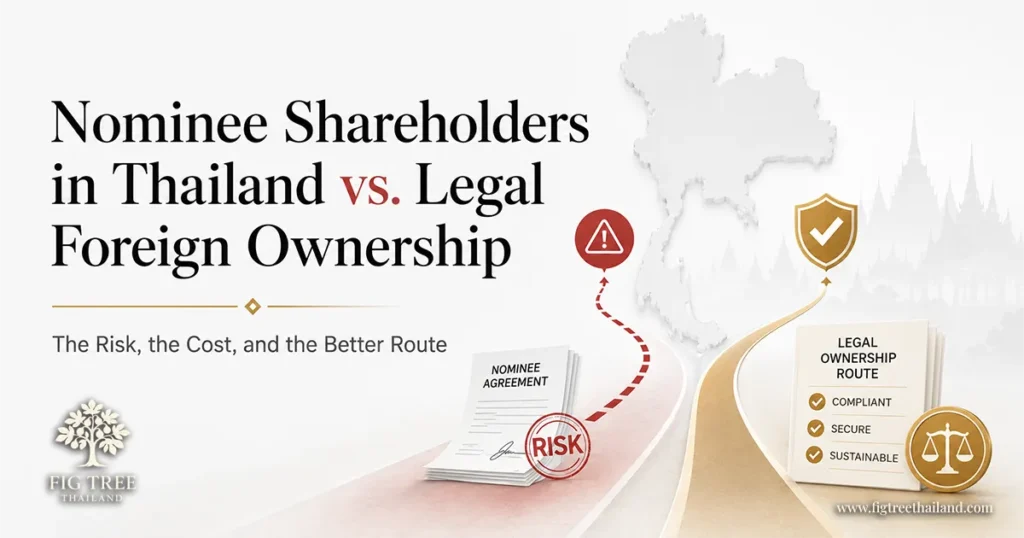
Foreign investors planning to enter Thailand often begin with one important question:
Can a foreigner own 100% of a company in Thailand?
The answer depends on the business activity, ownership structure, nationality of the investor, and whether the activity is restricted under Thai law.
In some cases, full foreign ownership may be possible. In other cases, the business may need a proper legal route, such as BOI promotion, a Foreign Business License, Treaty of Amity privileges for eligible U.S. investors, or a genuine Thai partnership.
This is where some investors hear a common suggestion:
“Just use a Thai nominee shareholder.”
At first, this may sound fast and convenient. It may appear to reduce setup time, avoid a more complex approval process, or lower the initial cost of entering the market.
However, if a Thai shareholder is used only on paper to hide the real foreign ownership, control, funding, or benefit of the business, the structure can create serious legal and practical risks.
A cheaper structure at the beginning is not always the lower-cost structure in the long run.
What Is a Nominee Shareholder in Thailand?
A Thai shareholder is not automatically a nominee.
Many foreign-invested companies in Thailand have real Thai partners, local investors, joint venture partners, or shareholders who genuinely participate in the business.
The risk begins when the Thai shareholder is only there on paper.
A nominee arrangement generally refers to a situation where a Thai person or Thai entity appears as the shareholder in the company documents, while the real funding, control, decision-making power, and economic benefit belong to a foreign investor or another party.
In practice, this may raise important questions:
Who actually funded the shares?
Who controls the business decisions?
Who receives the real benefit from the company?
Does the Thai shareholder have a genuine role, risk, and interest in the business?
If the legal documents and the real commercial arrangement do not match, the structure may become difficult to explain later.
Why Nominee Structures Can Look Attractive at First
A nominee structure can look attractive because it appears simple.
It may seem to help the company move faster. It may seem to avoid foreign ownership restrictions. It may also seem easier than applying for BOI promotion, a Foreign Business License, or structuring a proper joint venture.
But this is where many investors underestimate the real cost.
A weak ownership structure can create problems when the company needs to open a corporate bank account, apply for a license, enter into a commercial contract, bring in investors, apply for BOI promotion, go through due diligence, or deal with a shareholder dispute.
A structure created only to “get started quickly” may become the reason the business cannot move forward smoothly later.
The Hidden Risks of Using Nominee Shareholders
The risk of a nominee arrangement is not only legal. It is also operational, commercial, and practical.
1. Foreign Business Act Risk
If a nominee structure is used to avoid foreign ownership restrictions, it may be viewed as an attempt to circumvent the Foreign Business Act.
For investors, the issue is not only whether the company can be registered. The more important question is whether the structure can withstand review if authorities, banks, licensing officers, or business partners ask questions later.
2. Loss of Business Control
If someone legally holds shares in your company, your business depends on that person and that relationship.
Problems may arise if the relationship changes, if there is a dispute, or if the shareholder refuses to cooperate when documents need to be signed.
A nominee structure may look simple on paper, but it can become difficult in real business operations.
3. Banking and Licensing Questions
Banks, licensing officers, authorities, and reviewers may ask questions beyond the shareholder list.
They may want to understand who controls the company, who funded the business, who benefits from the operation, and whether the documents reflect the real commercial arrangement.
If the ownership structure is unclear, the company may face delays, additional questions, or difficulty explaining its setup.
4. BOI and Investor Due Diligence
If the company later applies for BOI promotion, seeks external investment, enters into a partnership, or prepares for sale, the ownership structure will likely be reviewed more carefully.
A nominee issue discovered later can affect trust, valuation, approval, financing, and deal execution.
For businesses that plan to grow, raise funds, or work with institutional partners, the ownership structure should be strong enough to pass proper due diligence.
The Real Cost of a Shortcut
A nominee structure may appear cheaper at the start because it avoids the visible cost of proper planning.
But the hidden cost may appear later through legal review, banking difficulty, licensing delays, shareholder disputes, tax questions, investor concerns, or restructuring costs.
This is why investors should not compare only the initial setup fee. They should compare the total risk of the structure.
A compliant route may take more planning and documentation, but it gives the business a stronger foundation.
A shortcut may save time at the beginning, but it can create delayed cost later.
Legal Routes to Foreign Ownership in Thailand
There is no single route that works for every business.
The right structure depends on the business activity, target ownership, investment plan, licensing requirements, nationality of the investor, and long-term operating model.
Common legal routes may include BOI promotion, a Foreign Business License, Treaty of Amity privileges for eligible U.S. investors, or a genuine Thai partnership.
BOI Promotion
BOI promotion may allow full foreign ownership for promoted activities, depending on the type of business and the conditions attached to the project.
This route may be suitable for businesses that support Thailand’s investment priorities, such as certain technology, digital, manufacturing, research and development, innovation, skilled service, or high-value activities.
BOI promotion can also provide other benefits, such as tax incentives, permission to bring in foreign experts, and other privileges depending on the approved activity and conditions.
However, BOI is not automatic.
Not every business qualifies. Even after approval, the company must operate within the approved scope and comply with BOI conditions.
Foreign Business License
A Foreign Business License may be available for certain restricted business activities under the Foreign Business Act.
This route may be relevant where a foreign-owned company wants to operate a restricted business in Thailand with proper approval.
An FBL application usually requires a clear explanation of the business activity, supporting documents, financial information, and a structure that can be justified under the relevant rules.
It should not be treated as a simple formality.
Before choosing this route, investors should review whether the business activity is restricted, whether approval is realistic, what supporting documents are required, and how the company will operate after approval.
Treaty of Amity
For eligible U.S. investors, the Treaty of Amity may provide additional ownership options in many sectors.
However, it is not a universal solution for every business. Certain activities remain restricted, and the company must still go through the required certification and registration process.
Where applicable, the Treaty of Amity can be an important route for U.S.-owned companies planning to operate in Thailand.
Genuine Thai Partnership or Joint Venture
A genuine Thai partnership can be a strong structure when the partner is real.
This means the Thai partner should have a genuine role, contribution, risk, and interest in the business.
The relationship should also be supported by proper agreements, clear responsibilities, decision rights, funding terms, profit sharing, exit arrangements, and dispute mechanisms.
A real partner is very different from a nominee.
A real partner helps build the business. A nominee only creates risk on paper.
Comparing Nominee Structures and Legal Ownership Routes
| Structure | Main Feature | Potential Advantage | Key Risk or Requirement |
|---|---|---|---|
| Nominee shareholder | Thai shareholder holds shares on paper while control is elsewhere | May appear fast and simple at the beginning | Legal risk, control risk, banking issues, licensing questions, and future disputes |
| BOI promotion | Investment promotion route for eligible activities | May allow full foreign ownership and other incentives | Not every business qualifies, and approved projects must comply with BOI conditions |
| Foreign Business License | Permission route for certain restricted businesses | Allows foreign-owned operation with proper approval | Requires review, documentation, and regulatory approval |
| Treaty of Amity | Route for eligible U.S. investors in many sectors | May allow majority or full U.S. ownership where applicable | Not available for every activity and requires proper certification |
| Genuine Thai partnership | Real Thai partner participates in the business | Can support local knowledge, relationships, and execution | Requires a real partner, proper agreements, and clear commercial terms |
What Should Investors Review Before Choosing a Structure?
Before setting up a company in Thailand, investors should review more than the shareholder ratio.
Important questions include:
What is the actual business activity?
Is the activity restricted under the Foreign Business Act?
Can the company qualify for BOI promotion?
Is a Foreign Business License required or realistic?
Is Treaty of Amity available for the investor?
Is there a real Thai partner, or only a person holding shares on paper?
Who will fund the business?
Who will control decisions?
What licenses, permits, tax registrations, and work permits will be needed?
Will the structure still work if the business grows, raises funding, or brings in new partners?
These questions should be reviewed before registration, not after the company has already started operating.
How Fig Tree Can Help
Fig Tree (Thailand) helps investors review foreign ownership structure before company registration, licensing, BOI planning, or partnership discussions.
We help clients assess practical routes such as BOI promotion, Foreign Business License, Treaty of Amity privileges, or genuine Thai partnership structures, based on the actual business activity and operating plan.
Our support can cover structure review, BOI or FBL assessment, Thai partner and business matching support, and coordination with accounting, tax, licensing, banking, and work permit requirements.
Contact Fig Tree for a confidential consultation before choosing your ownership structure.