



Thailand tax risks are one of the biggest blind spots for foreign-owned companies, even when filings are submitted on time. Most problems appear later during audits, BOI or immigration reviews, or investor due diligence.
Many foreign founders and executives believe that once a company is registered and an accountant is appointed, tax risks are automatically under control.
In reality, this is one of the most common and costly misunderstandings when operating a business in Thailand.
Most tax issues do not come from intentional non-compliance.
They come from not knowing how the Thai tax system actually works in practice.
The Common Assumption
Foreign business owners often assume:
• Accounting is mainly about bookkeeping and reporting
• If the accountant submits tax filings on time, the company is compliant
• Tax risk only arises if the company is making large profits
These assumptions may hold true in some countries.
They do not fully apply in Thailand.
The Reality in Thailand
In Thailand, accounting and tax are not just administrative tasks.
They are part of a regulatory and enforcement system where:
• Errors can trigger penalties even without bad intent
• Directors may be held personally responsible
• Issues often surface years later during audits or due diligence
Many companies only discover problems when:
• A tax audit begins
• Immigration or BOI compliance is reviewed
• Investors conduct financial due diligence
• The company prepares for restructuring or exit
By then, fixing the past is far more expensive than doing it right from the start.
Where Tax Risks Commonly Hide
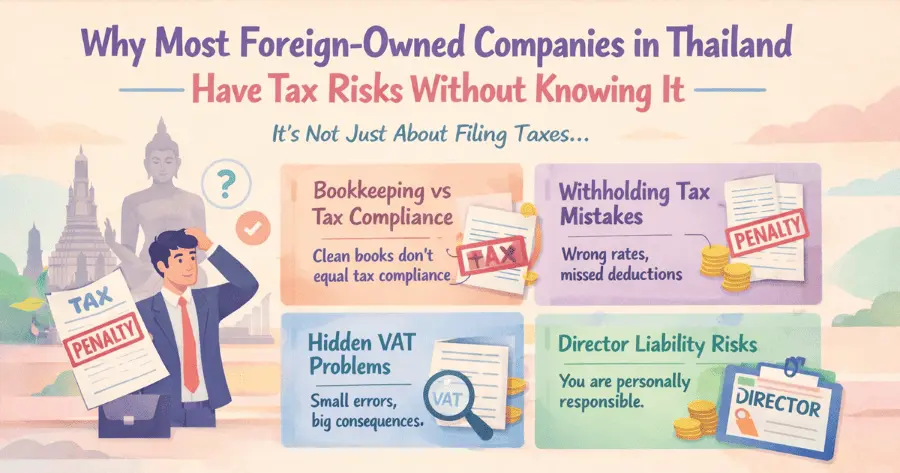
1. Bookkeeping vs Tax Compliance
Clean bookkeeping does not automatically mean tax compliance.
Common issues include:
• Incorrect expense classification
• Missing or invalid tax invoices
• Misinterpretation of deductible expenses
What may look acceptable in management accounts may not meet Thai tax requirements.
2. Withholding Tax Misunderstandings
Withholding tax is one of the most frequent problem areas for foreign-owned companies.
Typical mistakes include:
• Not withholding when required
• Withholding at the wrong rate
• Treating service fees as non-taxable
• Assuming overseas payments are always exempt
These errors often accumulate quietly and surface later, resulting in penalties and surcharges.
3. VAT Errors That Are Easy to Miss
VAT issues are not limited to high-revenue companies.
Risks often arise from:
• Late or incorrect VAT registration
• Improper VAT credit claims
• Timing mismatches between invoices and filings
• Cross-border services misunderstood for VAT purposes
Once flagged, VAT audits tend to be detailed and time-consuming.
4. Director’s Responsibility Is Often Overlooked
Many foreign directors are unaware that:
• Signing financial statements carries legal responsibility
• Penalties can extend beyond the company
• Relying on an accountant is not always a sufficient defense
This is especially important for founders and executives who are not involved in day-to-day accounting decisions.
Why These Issues Are So Common
Most tax risks arise because:
• Accounting is treated as a back-office task
• Advisors focus on filing, not risk analysis
• The business structure was set up without a tax strategy
• No one explains the local implications clearly to foreign management
This is not about negligence.
It is about the gap between expectations and local reality.
What Proper Accounting and Tax Management Looks Like
For foreign-owned companies, effective tax management should include:
• Accounting aligned with Thai tax regulations, not just reporting standards
• Ongoing review of tax positions, not year-end corrections
• Clear communication to directors about risks and responsibilities
• Practical guidance that considers real business operations
In this context, accounting becomes a risk-management function, not just a compliance function.
A Final Thought
In Thailand, good accounting does not necessarily reduce tax.
It prevents future problems.
For foreign-owned businesses, the real question is not
“Are we filing on time?”
but rather
“Do we actually understand our tax exposure?”